The British roads body National Highways has brought emission-free machines onto the Lower Thames Crossing site. As the Tunnelling Journal service reported, more than 30 zero-emission units are already at work on the schemes in Kent and Essex, and their number is to grow to roughly 150 during peak works in 2028. Excavators weighing 20 t, rollers, tractors, telehandlers and hydrogen-driven generators are among the equipment now in service.
A ban on diesel has applied across the scheme since 2025. Machinery runs on electricity, hydrogen or hydrotreated vegetable oil (HVO). Hydrogen supplied by the UK firm GeoPura powers the whole of the northern tunnel portal site. According to Tunnelling Journal, the programme is meant to make the investment the first large UK infrastructure project with a carbon-neutral balance during construction.
Tunnel and boring machine
At the heart of the undertaking sit two parallel road tunnels, each around 4.2 km long, which, according to Tunnelling Journal, are to be the longest road tunnels in the United Kingdom. Each will hold three traffic lanes in one direction. Boring will run beneath the Thames at depths reaching some 60 m.
Preliminary works started in March 2026, while the main construction and boring are scheduled for 2028. A new 23 km road will also be built, linking the A2/M2 in Kent with the M25 south of junction 29 in Essex and providing a new crossing of the Thames east of London.
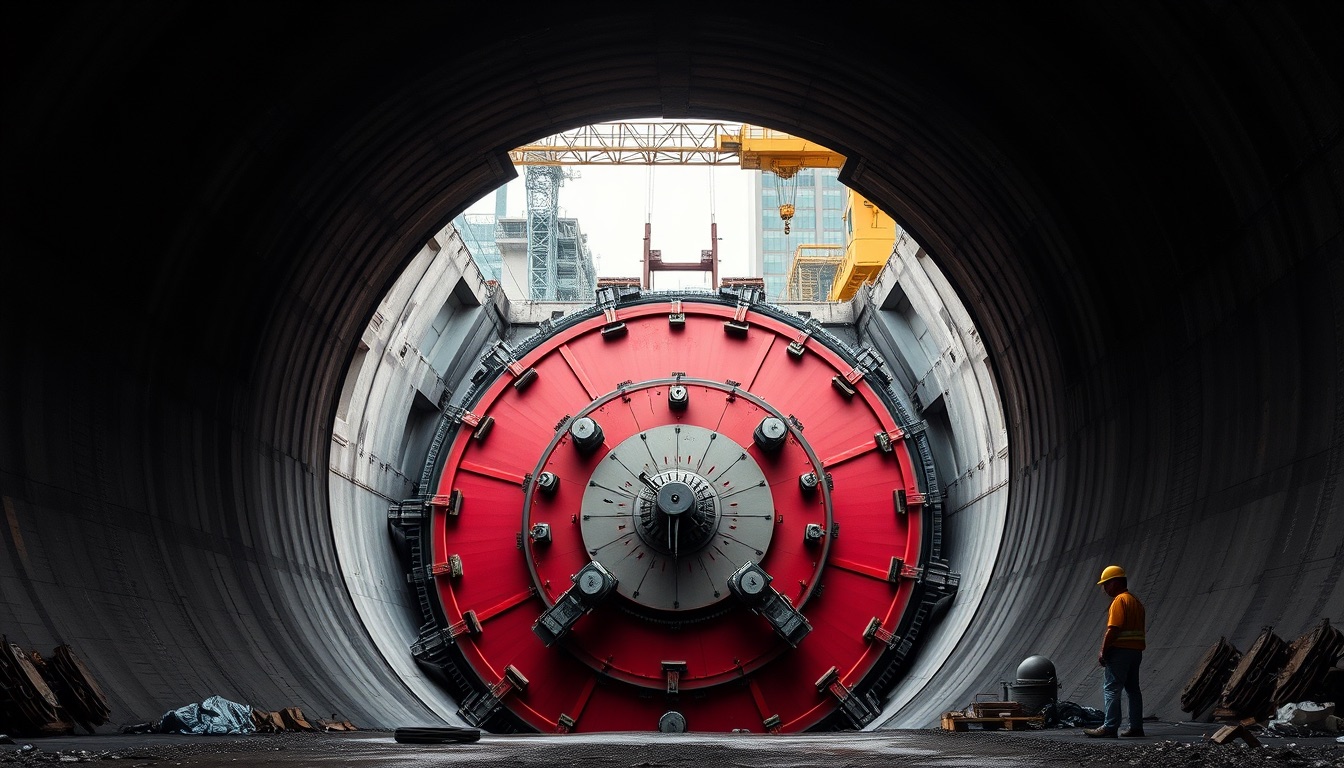
The tunnels and their approaches are being delivered by the Bouygues Travaux Publics - Murphy consortium (BMJV), one of the scheme's three principal contractors. In July National Highways confirmed that Herrenknecht will build the boring machine. The 16.4 m-diameter unit, of the Variable Density type, will, according to Tunnelling Journal, be the largest ever used in Europe. It is to measure about 120 m in length and weigh more than 5,000 t. It has been designed to work in changing ground conditions, including clays and chalk below the water table.
Instead of separate machines for each bore, the BMJV consortium will use a single unit. It will be launched from the northern portal near Tilbury in 2028, bore the first tunnel and then be turned around for the second. According to National Highways this will cut both cost and carbon footprint. The machine itself will be powered by electricity from renewable sources.
The project's chief executive Matt Palmer, quoted by Tunnelling Journal, said the use of emission-free machines showed that large construction investments could reduce their reliance on diesel. The scheme received development consent in March 2025, and the crossing is to enter service in the early to mid-2030s.