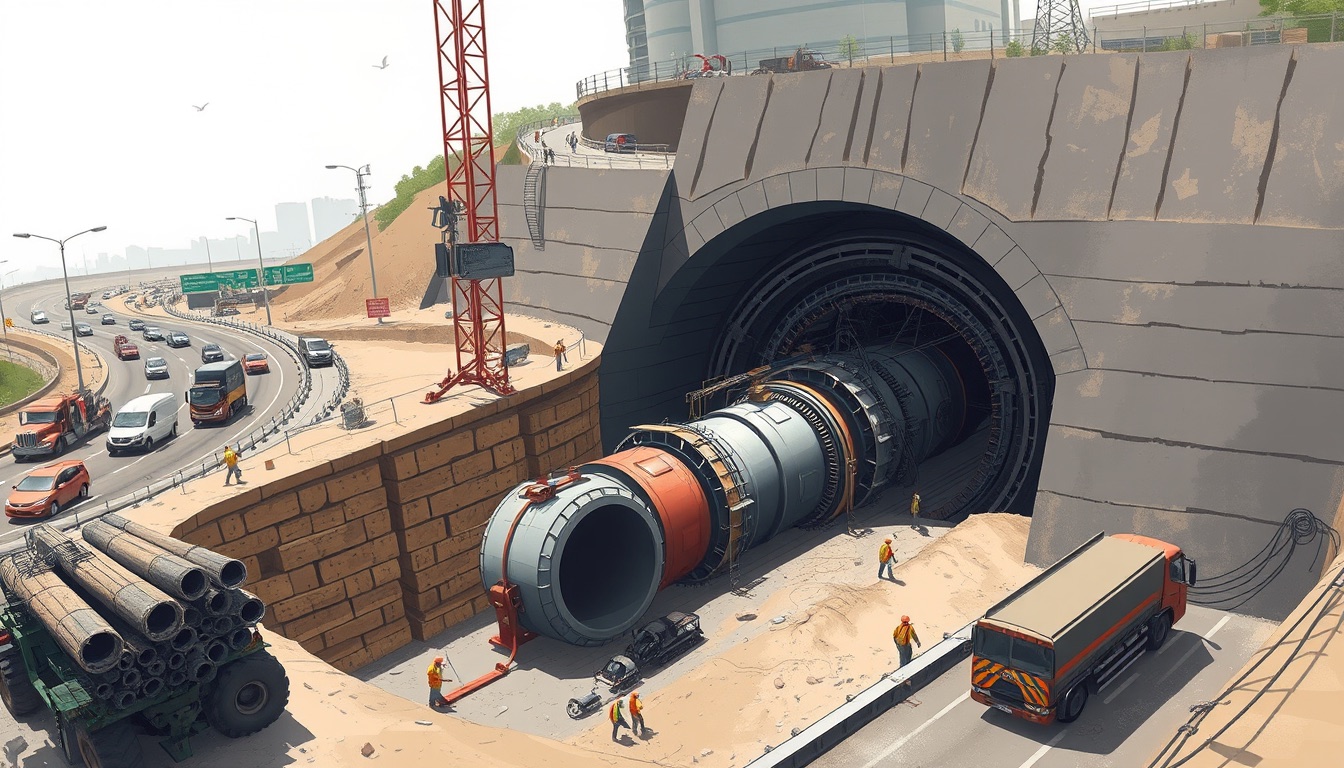
The Downtown Tampa Interchange program run by the Florida Department of Transportation (FDOT) ranks among the state's biggest transport infrastructure investments. Drainage work for the I-4/I-275 junction formed part of it, and that is where the microtunneling took place.
Scope
A welded steel casing was installed by slurry microtunneling. Its outside diameter is 62.5 inches and the total length reached about 2,773 ft (845 m). The bore passes beneath a route that carries some of Tampa's heaviest traffic.
Open-cut excavation was ruled out from the start. The corridor above is built up, the trench would have cut through live traffic and existing services, environmental conditions were tight and the crews had very little room to work. Under those circumstances a trenchless approach was the only sensible option.
Crew and machinery
Huxted Trenchless carried out the job, split into six separate drives. Individual lengths fell between roughly 247 ft and 763 ft. Launch and reception shafts were built from sheet piles, held by thrust blocks of reinforced concrete.
The casing was pushed forward by an ISEKI Unclemole TCC1350, a slurry machine that keeps the face supported at all times in water-bearing ground.
Planning and ground conditions
Early preparation covered detailed geotechnical probing and coordination of the existing utilities, with risk reduction as the goal. Assumed output was reduced to about half, since each joint in the casing had to be welded on site. The launch shafts were sized for jacking loads near 400 to 600 tons. Bentonite was pumped behind the machine and fed through lubricating ports in the casing to lower friction along the skin.
In the end the outcome was shaped less by the ground that had been expected than by one unplanned obstacle after another - buried remains thrown up repeatedly along the route. The full account appears in the 2026 North American Microtunneling Review.