Shichong Yang, Tianshuo Xu, Peng Zhang, Jingran Guo, Kaiqi Li and Shukang Ying published a paper on calculating the jacking force of straight steel pipes in the journal Buildings (16/19, article 3808). The work is titled "Calculation Method for Jacking Force of Straight Steel Pipe Jacking Considering Circumferential Deformation Effect", DOI 10.3390/buildings16193808.
The problem: a flexible pipe, rigid assumptions
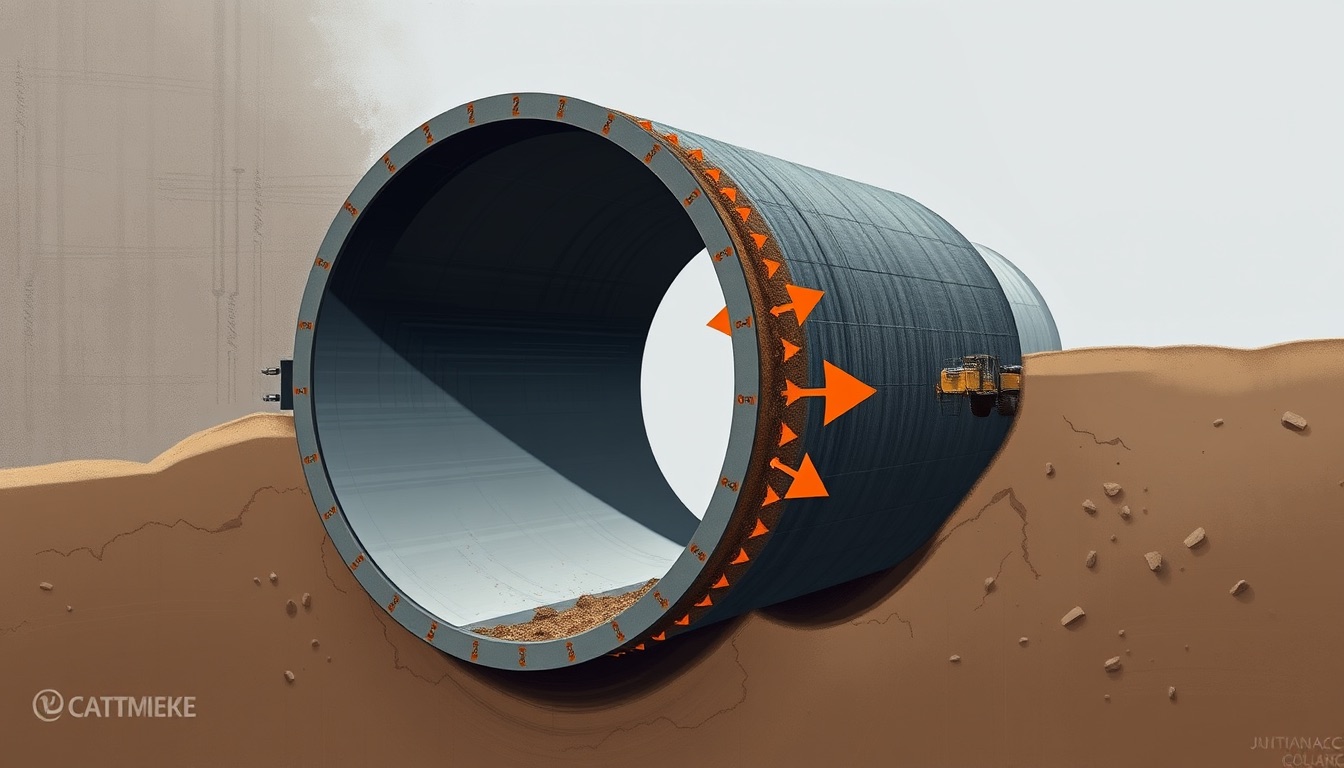
Flexible steel jacking pipes deform circumferentially under external load, which causes redistribution of earth pressure and additional frictional resistance. The authors point out that significant circumferential deformation makes the traditional assumptions of earth pressure as for a rigid pipe inapplicable.
The method
Two-dimensional numerical simulations were used to reveal a "quasi-elliptical" redistribution of earth pressure. The authors report that this distribution changes with burial depth, soil friction angle and the ratio of radius to wall thickness. Drawing on Spangler's theory and a full pipe-soil contact model, they propose a new analytical model that incorporates soil arching. The elastic centre method was used to solve the bidirectional deformations. An iterative fitting algorithm was introduced to quantify the non-linear coupling between bidirectional pipe deformation and earth pressure redistribution at various burial depths. Taking into account annular slurry lubrication, the authors built a jacking force calculation framework and validated it on an engineering case study.
The result
In the analysed case horizontal deformation reached 8 per mille of the pipe diameter, inducing a maximum additional horizontal earth pressure of 125.26 kN/m2, far exceeding traditional active earth pressure. The measured jacking forces fall within the model's prediction envelope, and the lower limit yields an average error of -19.3 per cent, which the authors judge to be a markedly better result than current specifications.
According to the authors the findings are meant to improve the design and construction control of large-diameter jacking of flexible steel pipes. All figures come from the paper's abstract (OpenAlex).